
2023–2026 Honda Civic Type R (FL5) Intercooler Buyer’s Guide
An intercooler upgrade for the 2023–2026 Honda Civic Type R (FL5) is about controlling charge-air temperature when your 11th Gen Civic Type R works hard. The right choice depends on how you drive, which parts you already own, and the installation you are prepared to undertake.
This guide explains the cooling basics and compares every verified HARDmotion FL5 intercooler listing from highest to lowest price. HKS, COBB, PRL, Wagner Tuning, RV6, and PLM each take a different approach. A larger price tag alone cannot tell you which will perform best on your car.
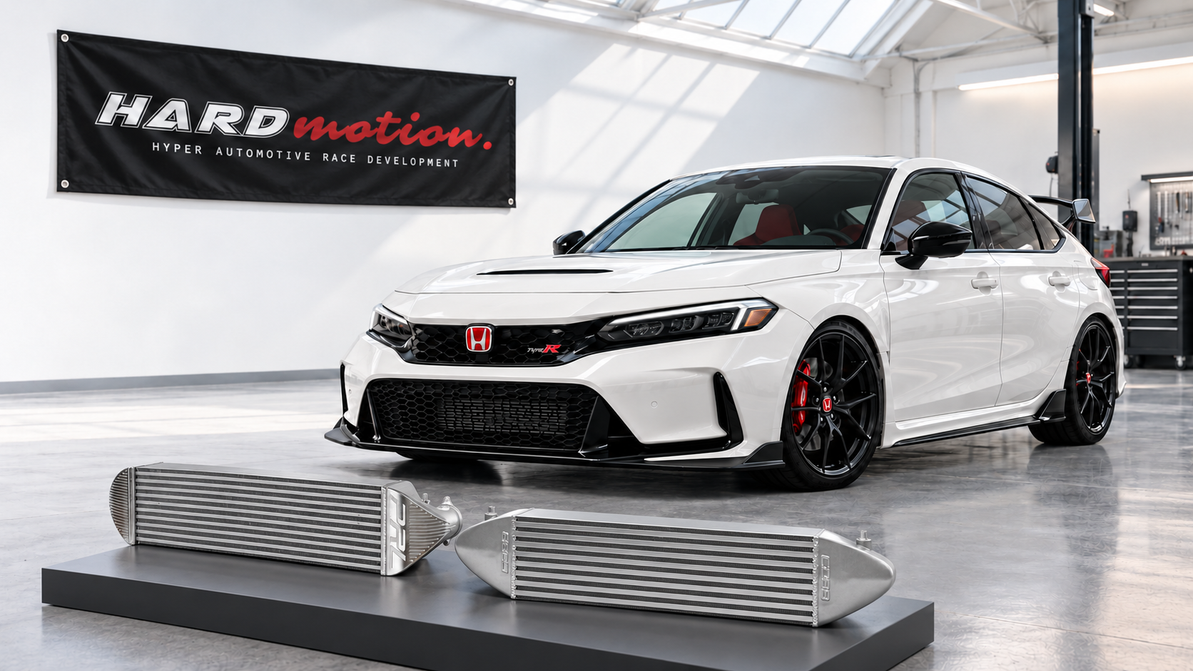
Hero image: AI-generated editorial illustration using HARDmotion product-photo references: PRL tube-and-fin (left) and COBB (right). Not an actual installation or test photograph.
THE SHORT ANSWER
Which FL5 intercooler would we choose?
Pick the priority first. These recommendations combine published manufacturer evidence with HARDmotion’s product-review perspective. They are buying judgments, not the results of a controlled all-brand test.
Sustained-cooling pick
PRL tube-and-fin · $999.99
Our evidence-led choice for repeated high-load use. PRL’s own extended-load comparison favors it over its bar-and-plate unit later in the test. Other brands were not included.
Response-minded street pick
PRL bar-and-plate · $879
The strongest stock-like-response evidence in this comparison: PRL’s development test reports lower core pressure drop and virtually no turbo-spool loss versus stock. This is not a fastest-spool ranking.
Lowest entry price
PLM HD Billet · $685
The budget pick when purchase price is the deciding factor. Budget for labor and inspect reused seals. Comparable intercooler-only cooling data remain limited.
Value tube-and-fin pick
RV6 · $749
A $64 step above PLM buys the lowest-priced verified tube-and-fin option here, with seals and two finishes. Choose for the package and design; it is not the lightest assembly.
Complete-kit value pick
COBB silver kit · $1,225
Our value pick when you also want charge pipes, couplers, clamps, and mounting support. It is $325 below the HKS full kit, with explicit 2026 U.S.-market fitment.
Premium craftsmanship pick
HKS full kit · $1,550
HARDmotion’s HKS review emphasizes finish, craftsmanship, and an integrated piping package. That supports a premium-quality preference, not a proven durability or cooling win over every rival.
THE COOLING BASICS
What an intercooler does, and why heat soak matters
Your turbocharger compresses intake air, adding heat. The FL5’s front-mounted air-to-air intercooler transfers some of that heat through its metal passages and fins into the outside airflow before the charge reaches the engine. Cooler air is denser at the same pressure.
Honda already equips the FL5 with a low-restriction intercooler. An upgrade aims to improve cooling and flow capacity for harder operating conditions. Repeated acceleration or sustained boost can add heat faster than the system sheds it. Rising charge temperatures and slower recovery are the heat-soak problems buyers want to manage.
The useful benefit is more repeatable performance. Temperature-related engine protections and calibration changes can affect output, but there is no universal horsepower gain or single temperature threshold that applies to every setup. Look for temperature behavior across consecutive runs, not just one impressive peak-power number.
Read temperature claims in context
Compare sensor location, ambient temperature, airflow, boost, gear, and recovery time. An intercooler-outlet probe and an intake-manifold sensor measure different places. Different manufacturers’ tests cannot fairly produce a cross-brand ranking unless the conditions and methods match.
BEYOND CORE SIZE
Tube-and-fin vs. bar-and-plate intercoolers
Both constructions use internal passages for hot charge air and external fins exposed to cooling airflow. Bar-and-plate cores build the passages from plates and bars. Tube-and-fin cores use tubes with fins between them; tube geometry and internal fins vary by design.
Bar-and-plate designs commonly bring substantial construction and thermal mass. Tube-and-fin designs often reduce weight, but the finished product matters more than the label. PRL lists 14.4 pounds for its tube-and-fin assembly and 22.2 pounds for its bar-and-plate unit; RV6 lists 24 pounds for its tube-and-fin product.
PRL’s own repeated-load testing illustrates the tradeoff: its bar-and-plate unit had an early temperature advantage, while its tube-and-fin unit stabilized cooler later. That is useful supplier-run data for those products and that test protocol, not proof that every tube-and-fin intercooler wins on track.
Compare these details together:
- Frontal area and ducting: How effectively outside air reaches the core.
- Pressure drop: Restriction through the charge-air path at a stated flow rate.
- Fin and end-tank design: Heat transfer, airflow distribution, and sealing.
- Installed weight and package contents: Complete assemblies and kits should be compared consistently.
In this lineup, HKS R-Type, PRL tube-and-fin, RV6, and Wagner Competition use tube-and-fin construction. PRL’s billet bar-and-plate and PLM use bar-and-plate. COBB specifies a Garrett aluminum core; compare its documented design and test information rather than assigning an unsupported construction label.
Extra core volume is a physical specification. It does not translate directly into the same percentage gain in cooling or horsepower.

WHY THESE PICKS
Cooling, engine response, value, and build quality
For the most cooling, define the driving cycle
A cooler that handles one acceleration run well may behave differently after sustained load. Our sustained-cooling pick is PRL tube-and-fin because PRL directly compared its two FL5 cores and the factory unit in an extended dyno protocol. In PRL’s same-day fourth-gear sequence, with no cooldown, consistent fan airflow, and mid-70s°F ambient, later cold-side temperatures were around 160–170°F for tube-and-fin and 190°F for bar-and-plate, with an OEM peak around 220°F. Bar-and-plate was roughly 5–10°F cooler early in the sequence. For a reader prioritizing repeated load, that is more relevant than buying the largest advertised core.
The boundary matters: this was supplier-run testing, starting temperatures differed, and it did not include HKS, COBB, Wagner, RV6, or PLM. We cannot call PRL the proven coldest of every brand. Wagner’s large frontal area remains a reason to investigate its different layout; dimensions alone do not decide the outcome.
HKS reports 30.3°C intercooler-outlet temperature versus 56.0°C stock at 7,000 rpm. COBB reports 97.93°F versus 138.2°F OEM following repeated runs. These are separate manufacturer protocols, so comparing their absolute temperatures with PRL’s heat-soaked figures would be misleading. COBB’s published power comparison also combines the intercooler with its Redline intake; that gain cannot be assigned to the intercooler alone.
For boost response, distinguish restriction from spool
Pressure drop tells you how much pressure is lost through the core under the measured conditions. It does not by itself measure how quickly the engine builds boost after a throttle input. Core volume, piping, operating conditions, and the rest of the turbo system also matter. Garrett explains that oversized piping slows transient response, while undersized piping increases pressure drop. A bigger intercooler is not automatically laggy, and a low-restriction claim does not prove faster spool. External width × height × depth includes metal and cooling-air passages; it is not internal charge-air volume. Lower metal weight or quicker thermal recovery also does not prove faster boost recovery.
PRL’s 2023 bar-and-plate development test is the clearest response evidence we found: it reports 0.4 psi average pressure drop versus 0.6 psi for stock and describes virtually no loss in turbo spool. That supports our response-minded street pick. It is a manufacturer prototype result, not a measured advantage over COBB or HKS, and those figures should not be transferred to PRL’s newer tube-and-fin unit.
For value, compare what you actually need
PLM is the entry-price winner at $685. RV6 costs $64 more and is the value tube-and-fin choice. PRL bar-and-plate costs $130 more than RV6, adding a different core design and more explicit published response evidence. PRL tube-and-fin adds $120.99 over PRL bar-and-plate, with lower published assembly weight and stronger sustained-load evidence within PRL’s comparison.
If you also need pipes, COBB’s $1,225 package is $325 below the HKS full kit. If your existing pipes are suitable, HKS core-only is $510 less than its full kit. Installation requirements can change the final value substantially, so compare installed cost rather than adding parts solely to match a higher-priced package.
For build quality, examine the whole assembly
HARDmotion’s HKS review places particular value on craftsmanship and finish. We carry that forward as a premium editorial preference. PRL and PLM emphasize billet end tanks, COBB combines a Garrett core with cast tanks and upgraded mounts, RV6 uses extruded tubes with cast tanks, and Wagner supplies cast tanks, hoses, and an air duct.
Billet is not automatically better than cast. End-tank geometry, weld quality, core construction, sealing, mounting loads, and the installed package all contribute. PRL’s updated O-ring grooves, COBB’s mounting support, and RV6’s included air seals are meaningful details to compare. No comparable long-term failure data support naming one brand the most durable here.
THE LINEUP
FL5 intercoolers at HARDmotion, highest price first
Nine listings cover seven distinct core designs. HKS has two packages and RV6 has two finishes, producing eight price-ranked purchase configurations. Prices below are the listed USD product prices checked on October 15, 2026, before tax, shipping, or installation. Price order is not a performance ranking. The HKS full kit and COBB include charge piping, so compare the complete contents as well as the price.
| Order | Intercooler | USD price | Core / package | Main consideration |
|---|---|---|---|---|
| 01 | HKS full kit13001-AH007 | $1,550.00 | R-Type tube-and-fin + charge pipes | Complete HKS package; modification required |
| 02 | COBB silver kit7H2500-SL | $1,225.00 | Garrett core + charge pipes | Pipes, couplers, clamps, and upgraded mounts |
| 03 | HKS core-only13001-AH008 | $1,040.00 | R-Type tube-and-fin without piping | HKS cooling core with factory-pipe compatibility |
| 04 | PRL tube-and-finPRL.1016.1.0 | $999.99 | Tube-and-fin / billet end tanks | 14.4 lb complete assembly, per PRL |
| 05 | Wagner Competition200001212 | $890.00 | Tube-and-fin / cast end tanks | Large frontal footprint; includes hoses and duct |
| 06 | PRL bar-and-platePRL-FL5-IC | $879.00 | Bar-and-plate / billet end tanks | Factory-pipe compatible; check trimming requirements |
| 07 | RV6 tube-and-fin · SilverIC_FL5_FMIC-SC | $749.00 | Extruded tube-and-fin / cast tanks | Silver and black have the same listed price |
| 07 | RV6 tube-and-fin · BlackIC_FL5_FMIC-BC | $749.00 | Extruded tube-and-fin / cast tanks | Silver and black have the same listed price |
| 08 | PLM HD billetPLM-IC-FL5 | $685.00 | Bar-and-plate / billet end tanks | Lowest listed complete-intercooler price |
Prices and availability can change. Both HKS intercooler listings were out of stock when checked. Check the product page for current availability before ordering.
SPECIFICATION-BASED REVIEWS
A closer look at each FL5 intercooler
These quick reviews compare published manufacturer specifications, installation guidance, and the current HARDmotion listings. We have not performed a controlled back-to-back dyno or track test of this lineup.
PRICE ORDER 01
HKS Full Intercooler and Piping Kit
$1,550.00USD
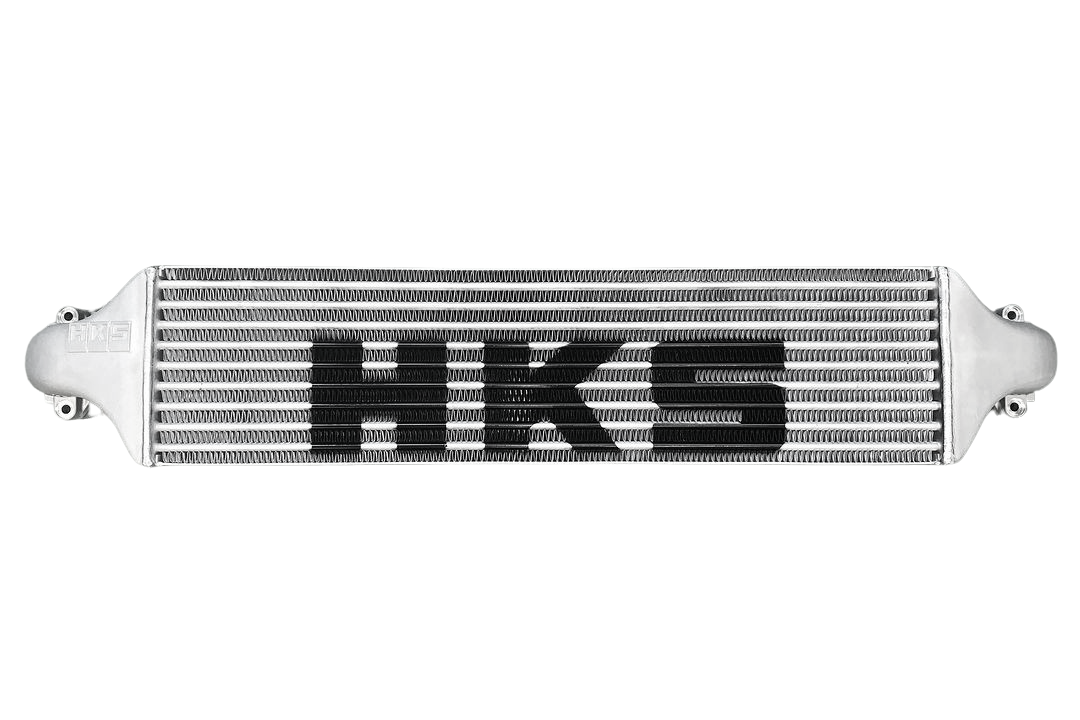
The HKS 13001-AH007 combines its intercooler with aluminum charge piping, silicone hoses, and installation hardware. HKS specifies a 695 × 178 × 100 mm R-Type tube-and-fin core and 22.4% more frontal core area than stock. The larger, smoother piping is designed to manage increased airflow and reduce hose expansion under boost.
Why consider it: A coordinated core-and-piping package for an owner who wants both upgrades together. Its higher price includes components missing from most core-only options.
Check before ordering: Air-guide modification, ambient-temperature-sensor relocation, and body-bracket work for the piping are required. HKS was out of stock when checked.
HARDmotion take: We see the HKS premium as a coordinated package and craftsmanship choice. Buy it for those priorities after accepting the installation work, rather than assuming its higher price guarantees the best cooling.
PRICE ORDER 02
COBB Silver Intercooler Kit
$1,225.00USD

The COBB 7H2500-SL is another complete package: a Garrett aluminum core, cast-aluminum end tanks, 2.5-inch mandrel-bent charge pipes, silicone couplers, constant-tension clamps, and upgraded mounts. COBB lists a 26.2 × 7 × 4.25-inch core and reports a 101% increase in core size over factory.
Why consider it: Buyers receive the surrounding plumbing and mounting support, making this a useful comparison against the HKS full kit. COBB explicitly lists 2023–2026 U.S.-market Type R applications.
Check before ordering: COBB says no vehicle modification is needed for the FL5 and supports the stock calibration. Confirm the exact part and model-year coverage in its current emissions documentation. The verified HARDmotion listing is silver.
HARDmotion take: This is our complete-package value pick. The included plumbing and mounting support make the $1,225 price more informative than comparing it against a bare intercooler.
PRICE ORDER 03
HKS Core-Only Intercooler Kit
$1,040.00USD
CORE-ONLY CONFIGURATION
HKS 13001-AH008
The listing has no product photograph. View the exact SKU and kit contents through the product link.HKS 13001-AH008 provides the HKS intercooler without the full kit’s charge-pipe package. It is the relevant option if you want the same 695 × 178 × 100 mm core while keeping compatible factory piping. The listing sits outside HARDmotion’s main FL5 intercooler category, so it is easy to overlook.
Why consider it: At $510 less than the full kit, it offers a lower-cost route to the HKS core when replacement piping is not part of your plan.
Check before ordering: Core-only still requires air-guide modification and temperature-sensor relocation. The extra body-bracket work applies to the piping installation. This listing was out of stock when checked; confirm exact model-year fitment.
HARDmotion take: Choose this when you want the HKS core and your existing charge piping remains suitable. The full kit is a different purchase, not simply a more expensive version of the same box.
PRICE ORDER 04
PRL Tube-and-Fin Intercooler
$999.99USD

PRL’s newer option pairs a CSF tube-and-fin core with CNC-machined 6061 billet-aluminum end tanks. PRL lists the complete assembly at 14.4 pounds, compared with 22.2 pounds for its bar-and-plate intercooler. EPDM O-rings, mounting screws, and a rubber edge guard are included.
Why consider it: It is a compelling shortlist option for owners prioritizing lower assembly weight and sustained-load cooling. PRL’s own prolonged-load comparison favored its tube-and-fin design later in the test; that result does not establish a cross-brand track winner.
Check before ordering: Use the supplied screws for its thinner mounting flanges. Review the current installation guide for your kit.
HARDmotion take: Our pick for the strongest documented sustained-load case in this evidence set. The combination of PRL’s comparison data and 14.4-pound assembly weight earns the recommendation, with the test limits above.
PRICE ORDER 05
Wagner Tuning Competition Intercooler Kit
$890.00USD

Wagner specifies a 580 × 400 × 70 mm Competition core, cast-aluminum end tanks, silicone hoses, an air duct, and mounting hardware. Its quoted 118% increase in frontal area and 145% increase in volume describe physical dimensions against its factory baseline. They are not percentages of improved cooling.
Why consider it: The larger frontal footprint and supplied ducting make this a distinctive package at $890. Buyers comparing it with a smaller, thicker core should look at the entire airflow path and installation layout.
Check before ordering: Wagner’s official FAQ identifies Competition cores as tube-and-fin, and its FL5 page specifies cast-aluminum tanks. Those sources resolve conflicting retailer wording. Allow for substantial access work despite the direct-fit description.
HARDmotion take: A strong shortlist option if you value the larger frontal layout and supplied ducting. Its dimensions are a design distinction, not proof that it outcools every smaller core.
PRICE ORDER 06
PRL Billet Bar-and-Plate Intercooler
$879.00USD

The PRL-FL5-IC combines a dense bar-and-plate core with billet-aluminum end tanks. PRL lists dimensions of 28.35 × 4.3 × 7.25 inches and 31% more surface area. Its 600-plus-horsepower support rating describes intended capacity, not power this part adds.
Why consider it: A $120.99 saving versus PRL’s tube-and-fin option, compatibility with factory charge pipes, and manufacturer-published repeated-run testing make it a practical comparison for a street-focused build. PRL states no ECU recalibration is required for this intercooler.
Check before ordering: The linked PRL installation guide includes trimming, sensor relocation, and sealing work despite broad no-cut wording elsewhere. Have the installer review the current guide for the supplied revision before quoting labor.
HARDmotion take: Our response-minded street choice. Its pressure-drop and spool-development evidence are persuasive reasons to consider it, even though the newer tube-and-fin better suits our sustained-load priority.
PRICE ORDER 07
RV6 Tube-and-Fin Intercooler
$749.00USD each finish
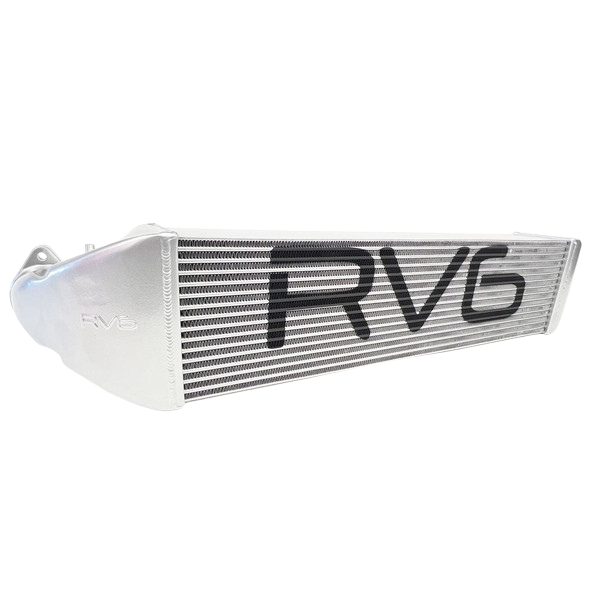
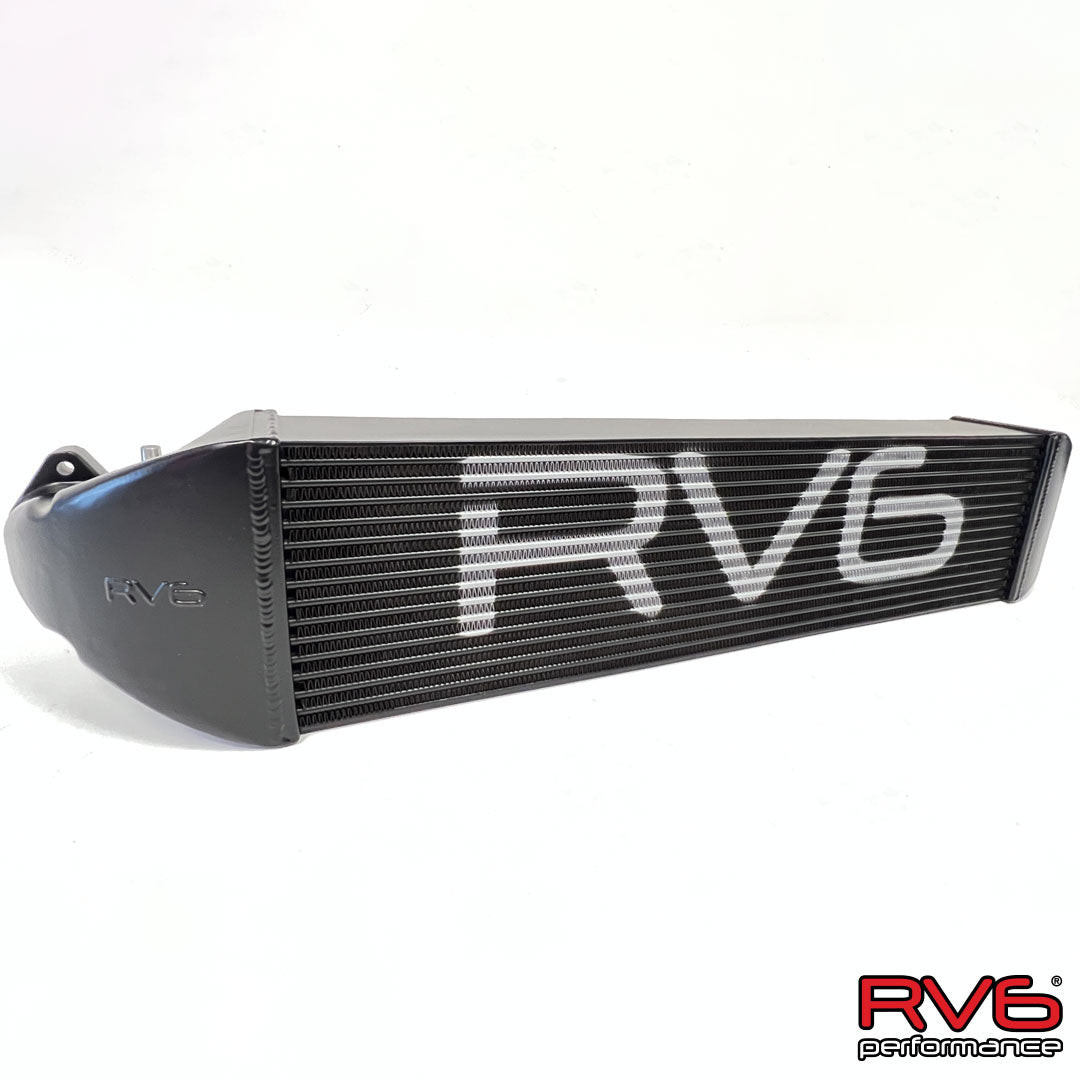
RV6 uses an extruded tube-and-fin core with internal vertical fins and cast-alloy end tanks. The core measures 27.5 × 7 × 4 inches. The package includes two O-rings, rubber air seals, an RV6 stencil, and a pry-tool kit.
Why consider it: This is the lowest-priced verified tube-and-fin option in the lineup, with silver and black finishes at the same $749 price. RV6 describes suitability for factory and upgraded turbo configurations.
Check before ordering: RV6 publishes a 24-pound weight, so tube-and-fin does not automatically mean the lightest assembly. Review its competition-use language and installation instructions. Choose the finish for appearance; no verified evidence here establishes a cooling advantage for black.
HARDmotion take: The value tube-and-fin option. We like the price and included sealing hardware; its published 24-pound weight keeps us from selling it as the lightweight choice.
PRICE ORDER 08
PLM HD Billet Intercooler
$685.00USD

The PLM HD Billet is the lowest-priced complete intercooler verified in this comparison. Its 715 × 184 × 110 mm bar-and-plate core uses billet-aluminum end tanks. PLM describes reuse of factory mounting brackets, O-rings, and hardware, with no ECU calibration required for installation.
Why consider it: At $685, it leaves more of the budget for installation and the rest of the build. The purchase focuses on the intercooler rather than a complete charge-pipe package.
Check before ordering: Inspect reused seals and confirm exact fitment. We did not find comparable intercooler-only temperature or pressure-drop data to rank it against the more expensive units. Its lower price is a budget distinction, not proof of superior or inferior cooling.
HARDmotion take: The straightforward budget choice. We would spend the savings deliberately on installation or other needed parts, while acknowledging the thinner comparative test record.
MATCH THE BUILD
How to choose an FL5 intercooler
Daily driving
Start with fitment, sealing, labor, and budget. PLM offers the lowest listed price. PRL bar-and-plate and RV6 provide different construction choices below $900. Ask which option fits your existing pipes and installation preferences.
Repeated high-load use
Prioritize sustained temperatures, recovery, ducting, and comparable logs. PRL’s lighter tube-and-fin design is worth investigating; Wagner’s larger frontal layout deserves a look. Neither price nor core label establishes a track winner.
A complete airflow package
Compare HKS and COBB when charge piping is also on the shopping list. If you already have suitable pipes, HKS core-only avoids buying another full package. Confirm compatibility before mixing brands.
Budget for installation and any required seals or modifications. Read the current manual before ordering, and check any competition-use or emissions restrictions for your exact part and location. Track preparation also needs separate attention to coolant and oil temperatures, since an intercooler directly cools the intake charge.
Related component: The HKS 13002-AH002 piping-only kit is listed at $840 and was out of stock when checked. It does not include an intercooler, so it is outside the price ranking above. HKS specifies body-bracket work for its installation.
COMMON QUESTIONS
FL5 intercooler FAQ
Does an FL5 intercooler need a tune?
Not automatically. PRL’s billet intercooler and PLM’s product information explicitly say no ECU calibration is required, and COBB supports the stock tune. Check your chosen part and other engine modifications; these statements do not cover every combination.
How much horsepower will an intercooler add?
There is no universal number. Fuel, calibration, temperatures, and test conditions affect the result. Preserving output across repeated runs is often a more useful goal than an isolated peak-horsepower claim.
Do I need upgraded charge pipes?
Not for every option. PRL’s billet intercooler and the HKS core-only kit support factory piping. HKS’s full kit and the COBB kit include piping. Check connections and package contents before buying additional parts.
Do these intercoolers fit the 2023–2026 Honda Civic Type R (FL5)?
Yes. All intercoolers compared in this guide are compatible with the 2023–2026 Honda Civic Type R (FL5). Compare package contents and installation requirements before ordering.
Will an intercooler fix coolant or oil overheating?
It addresses charge-air temperature. Coolant and oil overheating need their own diagnosis and cooling plan. An intercooler should not be treated as a complete solution to every track-temperature issue.
What is the best FL5 intercooler?
Our sustained-cooling pick is PRL tube-and-fin; our response-minded street pick is PRL bar-and-plate. PLM leads on entry price, RV6 on tube-and-fin value, and COBB on complete-kit value. These are criterion-based recommendations, not a controlled all-brand performance ranking.
Build a cooling setup that fits your Type R
Start with the HARDmotion FL5 intercooler collection, then use the direct product links above for the exact package and current price. Confirm your model year, existing charge pipes, and installation requirements before ordering.
Sources and comparison notes
HARDmotion product links above are the sources for price and store photography. Technical claims and installation cautions were checked against the manufacturer materials below. Manufacturer percentages and test results use different methods and should not be treated as directly comparable.
- Honda: 2023 Civic Type R press kit and cooling-system details
- Honda Japan: September 2022 FL5 launch
- Garrett: heat transfer and choosing an intercooler core
- Garrett: intercooler core engineering
- PRL: tube-and-fin, bar-and-plate, and OEM comparison
- HKS: FL5 core-only application and technical details
- HKS: full-kit installation manual
- PRL: billet intercooler installation guide
- Wagner: FL5 installation instructions
- PRL: 2023 bar-and-plate pressure-drop and spool-development testing
- Wagner: official Competition core-construction FAQ
- HKS: intercooler construction and R-Type design overview
- Garrett: piping size, transient response, and system optimization
- COBB: FL5 intercooler development and test context
Recent Posts
-
2023–2026 Honda Civic Type R (FL5) Intercooler Buyer’s Guide
An intercooler upgrade for the 2023–2026 Honda Civic Type R (FL5) is about controlling charge-air t …Oct 15th 2026 -
2022 Honda Civic Si Baseline Dyno & How much horsepower you can make with modifications.
2022 Honda Civic Si Baseline Dyno Run by Doug @ Hondata The 11th Gen Honda Civic Si has been a car …Aug 16th 2024 -
Top 5 Benefits of Installing Strut Bars on Your Honda or Acura
The full potential of your Honda or Acura by discovering the top 5 benefits of installing strut bars …Aug 1st 2024